

(Photo by Tim Mossholder on Unsplash)
On October 2nd, the Trump administration quietly warned their mass deportation campaign is creating a ‘structural crisis’ on American farms that threaten the nation’s food supply. Their solution? Import 119,000 mostly Mexican guest workers, while paying them less than what they estimate unauthorized workers currently earn.
This admission came in the form of an Interim Final Rule published in the Federal Register. The American Prospect and Washington Post have both ably covered this story and I particularly recommend David Dayen’s piece for highlighting the broader contradictions at the heart of the rule. I’ve been obsessing over this rule for weeks, and the wage math is even worse than the headlines suggest.
In the interest of full disclosure, I didn’t pitch these stories. Smart reporters simply noticed the same thing I did. But now that they’ve covered the important stuff, I can dive into the granular details that no editor would let see print.
I’m going to cite Philip Martin extensively throughout this piece. He’s the leading expert on immigration and agriculture, cited in Trump’s new rule and featured in John Oliver’s investigation on farm labor abuses. Consider this a curation of his research.
The Farm Workforce: Mostly Mexican But Changing Status
Let’s start with an overview of the American agricultural workforce. Philip Martin estimates the 115,000 US farm establishments employ about 2.5 million workers annually, 80% of whom were born in Mexico. That number is divided between 2 million crop workers and 500,000 animal agriculture workers. 850,000 of these workers are unauthorized while the remaining 1.6 million have legal status. That includes roughly 315,000 H-2A seasonal visa recipients, 92% of whom come from Mexico.
Most of these unauthorized workers entered during years of lax enforcement in the 1990s and 2000s and are now in their 40s and 50s. This aging workforce is less productive and less able to do strenuous manual labor. But they’re not being replaced with new unauthorized workers. Stricter enforcement in the mid-2000s, the 2008 recession, and improving conditions in Mexico all reduced migration flows into the US.
Martin’s analysis of Department of Labor surveys shows this change clearly: the unauthorized share of crop workers started at 10% in 1989-1990 and peaks 55% in 1999-2000. By 2013-2014 it had fallen to 47% and now sits at somewhere around 42% of crop workers. This decline began long before Trump took office and has been ongoing for decades.
That demographic shift has a practical impact: the workforce has become far less mobile. As workers age and settle in one location, far fewer qualify as “migrants” who travel between seasonal jobs. That creates a labor availability problems for farmers since crop seasons vary by location and crop type. Even the recent surges in unauthorized migration under Biden didn’t solve this, as new migrants overwhelmingly preferred stable city jobs over demanding seasonal farm work.
The Rise of the H-2A Visa
In response, employers have turned to another option: the H-2A visa. H-2A workers are usually younger, better educated, and more productive than older workers of any immigration status. But they’re also expensive: Martin estimates H-2A workers cost $30+ per hour in California versus $20+ for U.S. farm workers, once you factor in recruitment fees, processing costs, housing, and transportation.
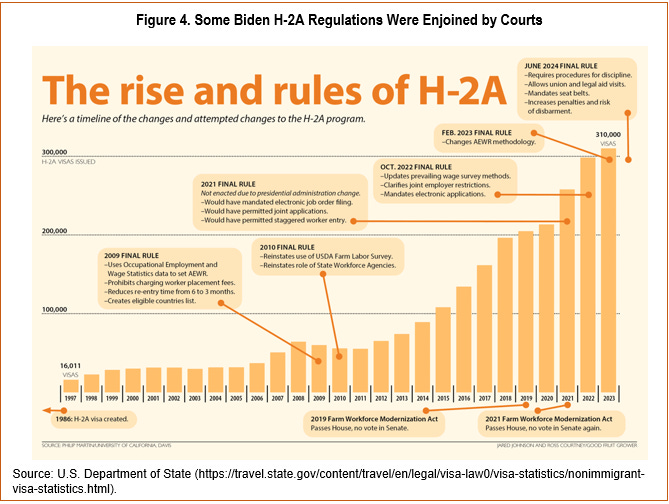
The Biden State Department produced a nice graphic showing how the H-2A visa has exploded over the past decade: from less than 50,000 in 2005 to over 300,000 today.
The new rule introduced on October 2nd concerns the “Adverse Effects Rate Methodology” or AEWR. The AEWR has existed in some form since the 50s to stop guest workers from undercutting American wages and employment. The Eisenhower Department of Labor found farms that primarily employed guest workers paid less than farms that employed only US workers. So it instituted state level mandatory wage floors for employers of guest workers, applying both to those workers and any U.S. employees in ‘corresponding’ employment.
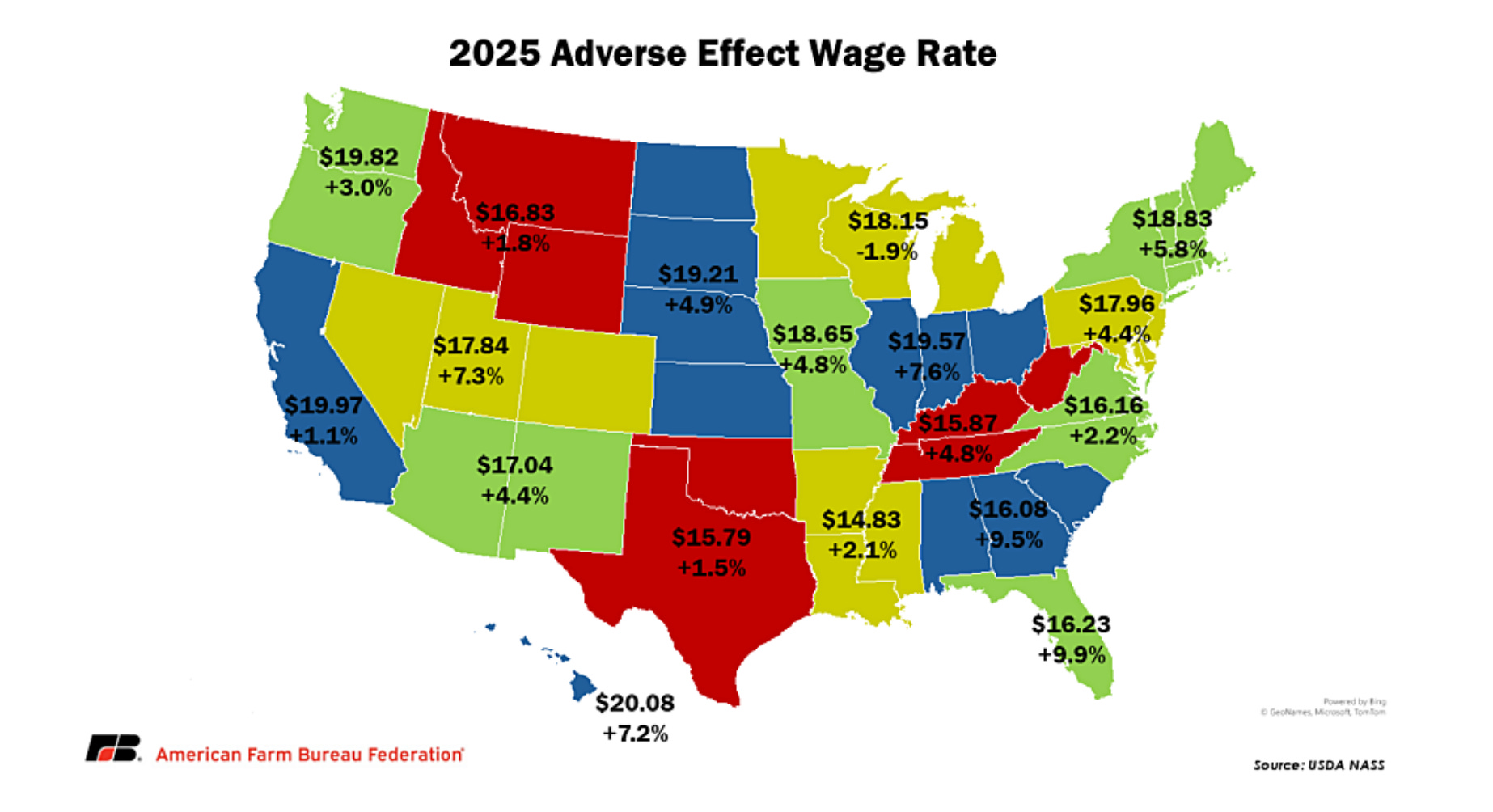
Today federal law requires employers to pay H-2A and corresponding US workers the highest of the AEWR, state minimum wage, federal minimum wage, or collectively bargained wage. The AEWR is usually on the high end of that range. It’s set at different rates for 15 farm labor regions, with individual rates for California, Florida, and Hawaii based off surveys of farm workers wages. Employers usually argue the methodology is wrong and pushes wages too high, while worker advocates say it’s too low and is frequently violated.
The Trump Department of Labor is unsurprisingly siding with employers, proposing to replace the AEWR with a brand new methodology. Their justification rests on three core claims. Let’s examine each one.
Claim 1: Deportations Raise Labor Costs Due to the AEWR
In their words, the “unreasonably high FLS-based AEWRs were only workable because agricultural employers could turn to low-priced illegal aliens,” which is now under threat due to Trump’s deportation campaign.
“Given the scale, speed, and investment in the federal government’s efforts to enforce immigration laws and restore the integrity of the U.S. border, the Department concludes that there will be significant labor market effects in the agricultural sector, which has long been pushed to depend on a workforce with a high proportion of illegal aliens. Because these illegal aliens often possess specialized skills suited to agricultural tasks and typically earn lower wages than authorized workers, their sudden and large-scale departure is expected to significantly increase labor costs for employers. These cost increases are very likely to limit the ability of agricultural operations to maintain current production levels or expand employment, resulting in downstream impacts on food supply and pricing.”
The timeline here is questionable at best: instead of H-2A forcing farmers to depend on unauthorized workers, in reality the long term decline of unauthorized workers is what has pushed farmers to the H-2A. These trends predate both Trump administrations.
Claim 2: Higher Labor Costs Put The Food Supply At Risk
But now, according to the Department, “without prompt action, agricultural employers will face severe labor shortages, resulting in disruption to food production, higher prices, and reduced access for U.S. consumers, particularly to fresh fruit and vegetables.”
In their words, there “is ample data showing immediate dangers to the American food supply.” They describe a “structural, not cyclical, workforce crisis”—driven by the loss of what they call the “mobile illegal alien workforce.” Citing the decline in illegal border crossing and increased enforcement, they claim this “near total cessation of the inflow of illegal aliens” threatens “the stability of domestic food production and prices for U.S consumers.”
Ominously, they even suggest “[s]uch significant economic impacts not only create tangible and imminent economic harms, but they structurally disrupt the ordinary operations of the U.S. agricultural sector, resulting in shortages of agricultural commodities that cannot be supplemented with imports in the near-term.”
Sounds bad!
Claim 3: American Workers Are Simply Too Expensive
The following paragraph sums up their entire argument. Farmers are “economically reliant” on low paid unauthorized workers and even higher wages aren’t enough to tempt Americans into farm work:
“Decline in the illegal alien population will only exacerbate this already pressing mismatch in the agricultural labor market and deprive growers of a relatively cheaper labor supply on which they have become economically reliant. (A substantial body of research estimates that illegal alien workers earn between four percent and 24 percent less than similarly situated legal workers, giving employers a strong financial incentive to hire illegal labor.) Despite rising wages, there is no indication that unemployed or marginally attached U.S. workers are entering the agricultural labor force in meaningful numbers. Without swift action, agricultural employers will be unable to maintain operations, and the nation’s food supply will be at risk.”
Keep that statistic of unauthorized workers earning 4%-24% less than similarly situated authorized workers in mind for later. That figure is the academically accepted ‘wage penalty’ faced by unauthorized workers once you adjust for factors like age, education, and other demographic characteristics. The Biden White House linked to several of these studies here if you’re interested.
Back to the rule. Here’s where it gets truly revealing. The Department doesn’t just say wages can’t go up—they say American workers are being unreasonable to expect them to:
“Turning to the potential reliance interest of U.S. workers in the current methodology, the evidence relied on throughout this IFR strongly indicates that such reliance is tethered to a labor market that is dramatically changing and increasingly unstable. As discussed, the current and imminent labor shortage and the subsequent natural correction of a labor market artificially impacted by illegal aliens cannot be avoided. The Department simply has no evidence of the existence of a substantial population of U.S. workers who are willing and able to accept wage rates that are reasonable and proportionate to agricultural work but are deterred from entering agricultural work by AEWR-priced H-2A workers.”
In other words, any wages that an American would accept are in turn unacceptable to employers.
The Solution: Cutting Wages for EVERYONE
This new rule replaces the old AEWR with a new two-tier skill level system for every state. The Administration estimates at least 92% of guest workers would fall under the entry level “Skill Level I,” as 92% of H-2A workers are now paid at the base AEWR rate.
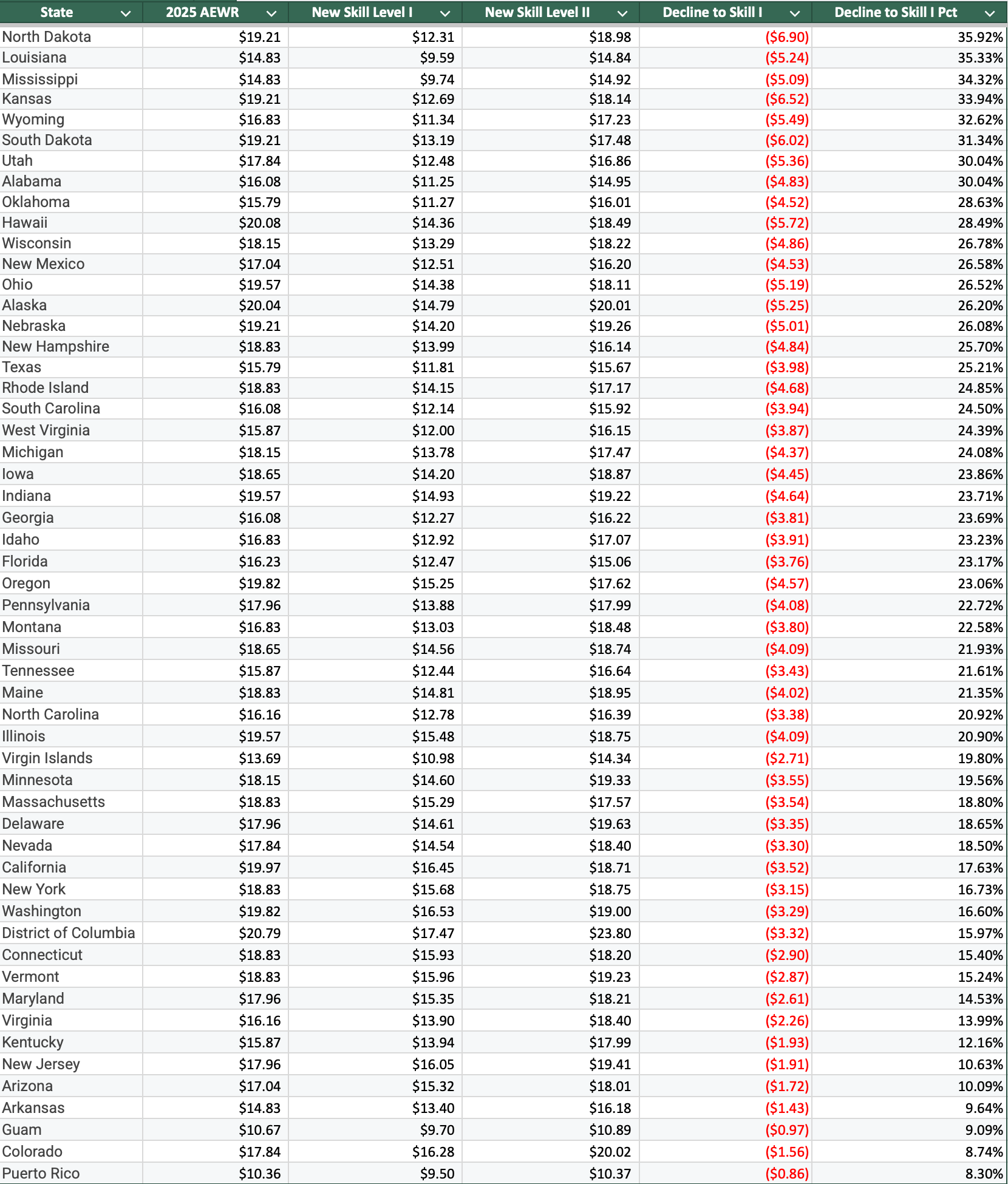
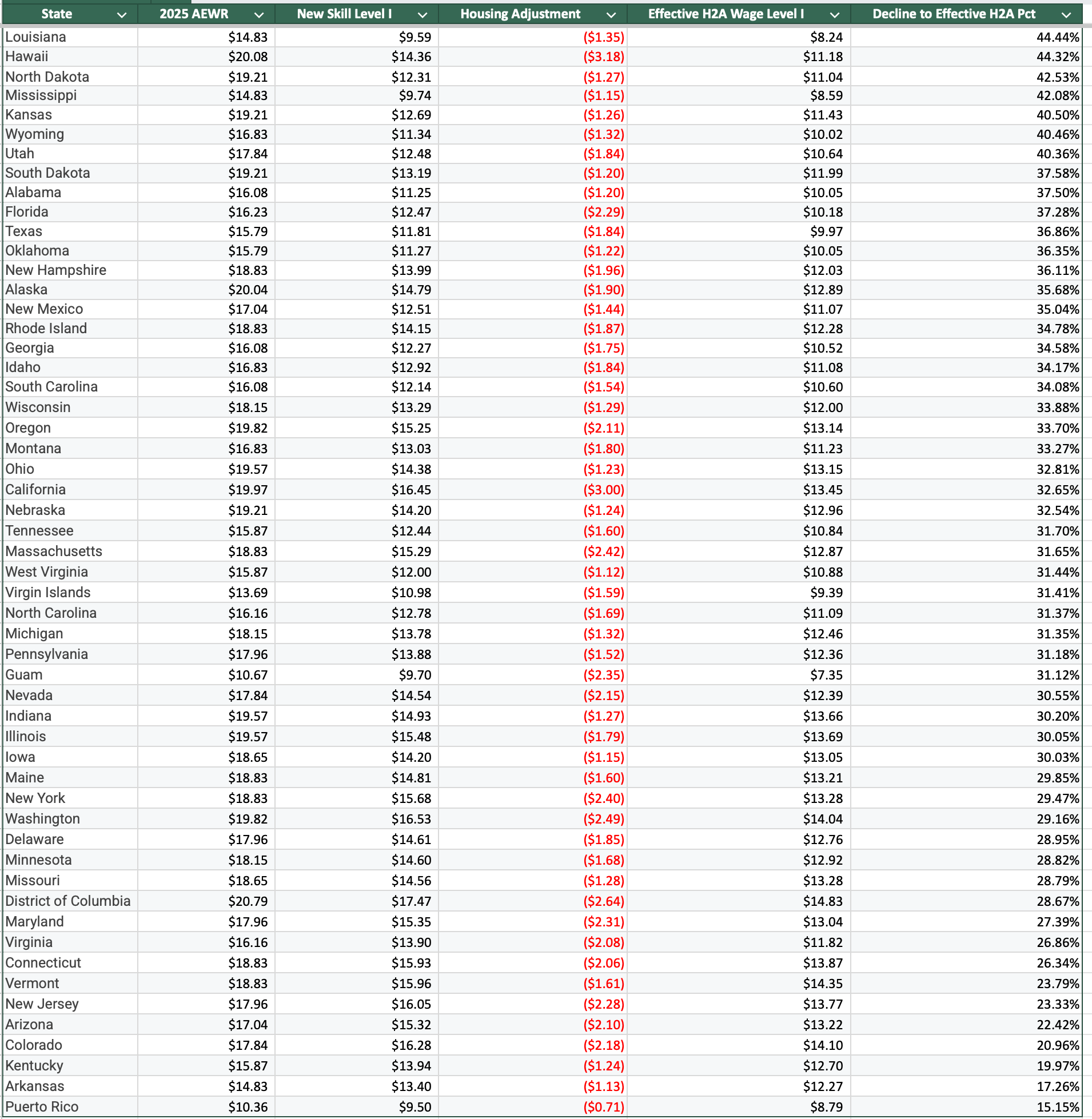
Remember the claim unauthorized workers earn 4-24% less than legal workers? According to my calculations, the cut from current AEWR to Skill Level 1 would reduce legal wage levels by 8.3% to 35.9%. So wages for H-2A and corresponding US workers could now be set below what the administration estimated unauthorized workers presently earn!
Here’s my analysis breaking down the wage cuts by state:
But it gets worse, as the rule goes even further to cut wages. I mentioned earlier that H-2A workers are often more expensive once you account for employer provided housing and similar non wage compensation. The Department declares this deeply unfair for American workers who pay their own rent and requires an additional pay cut:
“the Department is implementing a standard downward adjustment to the hourly AEWRs that accounts for the compensation disparity U.S. workers face when H-2A workers are being paid for work performed under the same work contract but, unlike most U.S. workers, receive additional non-wage compensation in the form of free housing. Those U.S. workers who are reasonably able to return to their permanent places of residence at the end of each workday, must continue to bear these essential costs from their wages, despite often being offered and often paid the same wages as H-2A workers. Thus, the result is an adverse disparity in compensation where the effective wage rate of U.S. workers is lower than that mandated for H-2A workers under the same work contract, which the Department views as prohibited by the statute that this IFR seeks to correct.”
The traditional economic logic would be if guest workers cost more, employers have an incentive to hire cheaper U.S. workers instead. The Department flips this: they claim that cutting H-2A wages protects American workers by eliminating the ‘compensation disparity.’
Once you include this housing adjustment, which only applies to H-2A workers, they can now be paid anywhere from 15.5% to 44.4% less than before.
The Upshot: Lower Wages for All and More Guest Workers
To be clear, employers must still pay H-2A workers the highest of the adjusted AEWR, prevailing, collectively bargained, and minimum wage rates. Still the Department of Labor estimates this rule change will serve as an over $20 billion wage transfer from H-2A workers to their employers.
The Department even admits that the AEWR cut “also represents a wage transfer from corresponding workers, not only H-2A workers” but “the Department lacks sufficient information about the number of corresponding workers or their wage structures to measure these impacts.”
Translation: it’s a wage transfer from American workers whom either must accept lower wages or be replaced by cheaper guest workers.
The Department expects this rule to bring in 119,000 additional guest workers by 2034, from a projected employment of 383,000 to 502,000. But as Dayen notes, some farmers are worried they may not be able to attract workers at these lower wages. Meanwhile Washington Post quoted immigration restrictionists have criticized this about-face on prioritizing American workers. Project 2025 even proposed phasing out H-2A altogether in favor of subsidizing the mechanization of agricultural labor.
Mechanization would take years and billions in investment. This administration has chosen the faster path: a largely invisible expanded guest worker program with limited labor protections and potentially lower wages than the unauthorized workers they’re deporting.
The argument is cynical, yet elegant in its own way: Deport unauthorized workers to create a ‘crisis,’ ignoring that the demographic shift in question has been happening for decades. Use that crisis to justify importing more guest workers than ever. Slash their wages below what you said unauthorized workers earned, undercutting American workers in the process.
And call it ‘America First.’